
What Digital Marketing in 2026 Will Look Like: AI-Powered Strategies Driving Business Growth in the UAE
In the future, digital marketing (2026) can no longer be characterized by sheer visibility or presence on the Internet. It has developed into a fully intelligent ecosystem driven by artificial intelligence, automation, predictive analytics, and real-time behavioral intelligence. The UAE and global businesses are shifting toward a data-first approach where technology and strategy work together to deliver measurable growth.
With this dynamic environment, organizations are being empowered by companies such as WaveRiser to build advanced digital platforms that transform traditional marketing into performance-driven systems powered by digital transformation.
Digital Marketing Evolution in 2026
In the last few years, digital marketing has taken a significant turn. AI-driven precision has replaced the need for large-scale, broad-target campaigns.
In 2026, marketing is no longer reactive—it is predictive.
Artificial intelligence now analyzes user intent, behavior, and engagement signals in real time. This enables businesses to deliver the right message at the right moment with far greater precision than ever before.
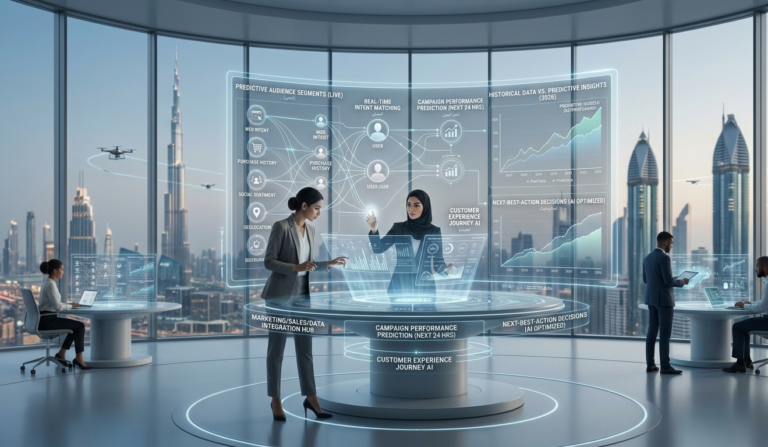
Key shifts include:
- Transition from manual marketing to AI-powered automation
- Stronger focus on customer experience over traditional advertising
- Real-time behavioral decision-making systems
- Integration of marketing, sales, and data platforms
- Predictive insights replacing historical reporting
These changes are transforming how brands build relationships with customers in competitive markets such as the UAE.
AI as the Engine Behind Future Marketing
AI is no longer a supporting marketing tool—it is the foundation of digital strategy in 2026. It drives every stage of the marketing lifecycle, from campaign creation to customer engagement.
AI systems now handle:
- Audience segmentation with precision
- Automated campaign optimization
- Dynamic content generation
- Predictive customer journey mapping
- Real-time performance adjustments
Businesses benefit through AI-driven marketing
Smarter audience targeting, automated campaign optimization, personalized content delivery, predictive customer journey mapping, and real-time performance adjustments have become standard advantages for businesses using AI-powered systems. These capabilities significantly reduce wasted advertising spend while improving ROI.
AI also minimizes advertising inefficiency by continuously identifying strategies that generate the highest conversions. This is especially important in fast-growing, highly competitive markets like the UAE.
Hyper-Personalization and Customer Experience in 2026
Customer expectations have changed dramatically. By 2026, generic marketing is no longer effective. Users now expect highly personalized digital experiences across every interaction.
Hyper-personalization uses AI and machine learning to adapt content, offers, and messaging based on user behavior, preferences, and past interactions.
This includes:
- Personalized website experiences
- Dynamic email content
- AI-driven product recommendations
- Location-based promotions
- Behavior-triggered notifications
This approach significantly improves engagement and conversion rates. Businesses that fail to personalize risk becoming irrelevant in an increasingly competitive digital ecosystem.
Growth of Voice Search and Conversational Marketing
In 2026, voice search plays a major role in digital marketing. With the rise of smart assistants and voice-enabled devices, users now search using natural speech instead of typed queries.
Modern marketing focuses on:
Natural language keyword optimization, conversational content formats, question-based search targeting, and local voice search optimization. These strategies help brands align content with how users naturally speak and interact with search engines.
At the same time, conversational marketing powered by AI chatbots is becoming essential. Users expect real-time responses on websites, apps, and social platforms, making instant interaction a key driver of conversion success.
Dominance of Short-Form and Interactive Content
Attention spans continue to decrease in 2026, making short-form and interactive content one of the most effective digital marketing strategies.
Brands are investing in:
- Short videos
- Interactive polls
- Live streaming experiences
- AR/VR engagement formats
- Gamified marketing systems
This shift turns users from passive viewers into active participants, increasing emotional engagement and brand recall.
Ethical Marketing and Data Privacy in the Digital Era
As digital marketing becomes more data-driven, concerns around privacy and transparency continue to grow. By 2026, ethical marketing practices are no longer optional.
Consent-based data collection ensures transparency in how information is gathered. Secure data systems protect user information while ethical use of AI ensures fairness in marketing decisions. At the same time, reduced reliance on third-party cookies reflects a shift toward more responsible digital ecosystems.
Trust has become one of the most important drivers of customer loyalty. Businesses that prioritize ethical data usage are more likely to build long-term relationships with their audiences.
Omnichannel Marketing Integration
Customers now interact with brands across multiple platforms simultaneously. Omnichannel marketing ensures a seamless and consistent experience across all touchpoints.
These include:
- Websites
- Social media platforms
- Mobile applications
- Email campaigns
- Physical retail systems
Centralized data systems connect all channels, allowing businesses to track customer journeys and maintain consistent messaging across platforms. This improves customer experience and strengthens brand consistency.
AI-Powered SEO and the Evolution of Search Engines
In 2026, artificial intelligence plays a major role in search engine optimization. Traditional keyword-based SEO is no longer enough.
Modern search optimization focuses on:
- Semantic search understanding
- AI-generated search summaries
- Content authority and expertise
- User experience signals
- Real-time content relevance
SEO has evolved into a system where content must be optimized not only for humans but also for AI-driven search engines that understand intent and context.
Smart Campaign Automation Systems
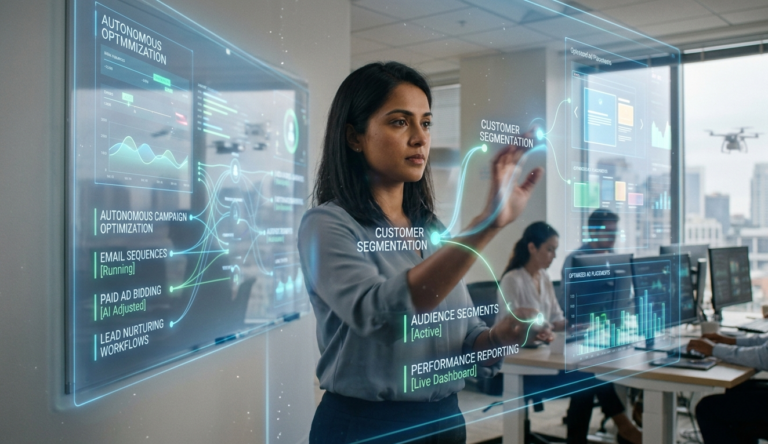
Marketing automation has reached its peak in 2026, allowing businesses to run entire campaigns with minimal manual effort.
Automation systems now manage:
- Email sequences
- Paid ad optimization
- Lead nurturing workflows
- Customer segmentation
- Performance reporting
This reduces operational workload while improving consistency and accuracy across campaigns.
Digital Transformation Support Through WaveRiser
WaveRiser plays a key role in helping businesses adapt to modern digital marketing systems. With advanced automation tools, AI-driven infrastructure, and analytics platforms, organizations can build scalable and future-ready marketing ecosystems.
Key support areas include:
Digital transformation consulting, AI-powered marketing integration, cloud-based infrastructure support, data analytics and performance tracking systems, and automation and workflow optimization.
This ensures businesses remain competitive in a rapidly evolving digital environment where adaptability determines success.
Digital Marketing Future: 2026 and Beyond
Digital marketing is evolving into a fully automated, predictive, and deeply AI-integrated ecosystem. Marketing systems are becoming self-learning platforms capable of optimizing performance in real time.
Future trends include:
- Fully AI-managed marketing ecosystems
- Emotion-based customer targeting
- Advanced real-time personalization engines
- AR/VR-driven marketing experiences
- Fully voice-controlled search and commerce
Businesses that adopt early will gain a strong competitive advantage in engagement, conversion rates, and long-term market positioning.